Home / Chapter 3

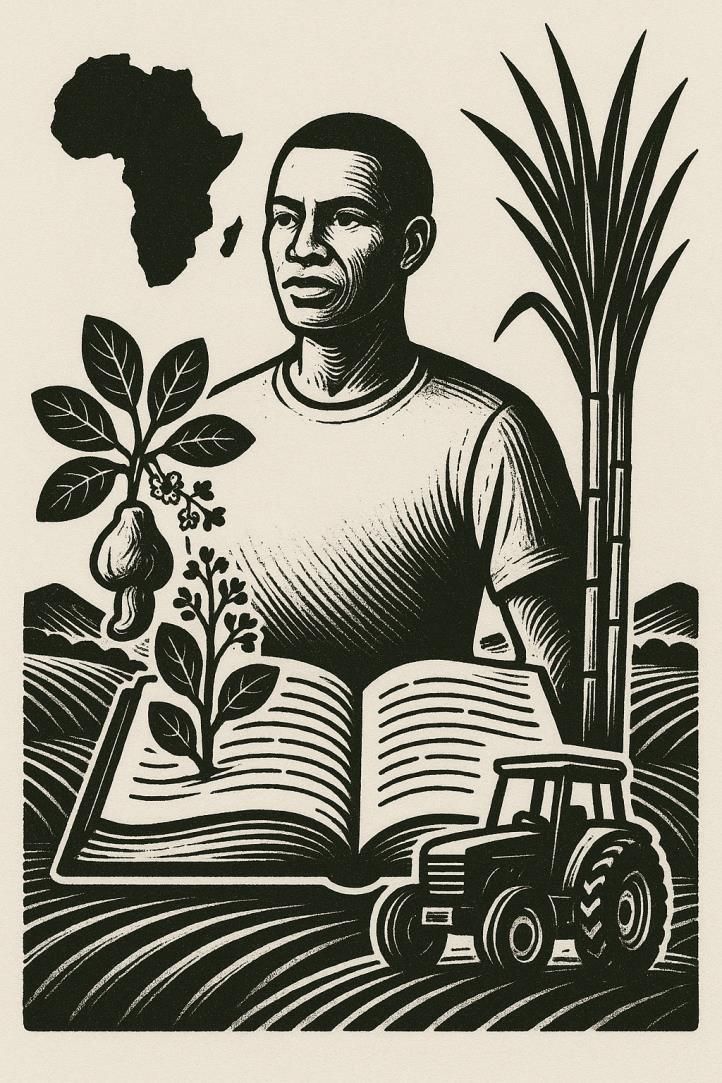
Woodcut illustration of a young African farmer beside cashew, sugarcane, an open book and a tractor
Chapter 3 of 5 · 2003–2025

Beyond Kapunga: the same idea, new soils

Rice was not the only crop he believed in. In Zanzibar's sugar, Kenya's cashew and Mozambique's pigeon peas, he tried the same idea: put the farmer at the centre and build the system around them. Not every attempt worked the first time.

2003Zanzibar Sugar · Mahonda, Zanzibar

The book with the green cover

When he took over EFC from David Musselwhite, he found a book with a green cover in his predecessor's office cabinet: The Sugar Industry in East Africa, published in 1965. He read all 115 pages in one sitting. It showed him how farming in the region had been organised around the export of commodities from its vast irrigated lands.

Decades later he took on what was left of Zanzibar's sugar industry. The Mahonda factory, begun with Chinese support in 1974 about 25 kilometres north of Zanzibar town, had a 3,900-acre nucleus farm and was designed to make 40 tonnes of sugar a day. Under bad management it struggled to reach even 14 per cent of capacity and shut entirely in 1992. The plantation turned into jungle.

In 2003 he founded Zanzibar Sugar Factory Limited (ZSFL), acquiring the mill and 4,000 acres of the defunct plantation. With finance from the East African Development Bank he raised the mill's capacity from 500 to 800 tonnes of cane a day and added 1,380 acres from nearby outgrowers.

2011The failure

Learning the people factor

It did not work. Cane cutting by hand is gruelling, and labour productivity did not rise even after modern labour regulations were introduced. The outgrower scheme failed. In 2011, after $40 million had been invested, the plant shut down, with its development-bank loan unpaid.

“I learnt by experience the criticality of people factor for sugarcane plantations.”

Mahesh Patel, Abundance, Chapter 8

He did not walk away. In 2013 he brought in Misra Costech Sugar Company of India to re-engineer the factory. The loans were repaid and another USD 15 million was invested. In March 2016 sugar production began again under a new brand, Kisiwa, meaning “island” in Kiswahili. The mill now runs entirely on energy it generates from its own cane, with no outside power needed during production.

The most important change, he says, was helping the farmers become prosperous again.

A farmer's story · Bumbwi Pepo village, Zanzibar

Juma Ramadhan Chanzira, cane grower, 70+

He started supplying ZSFL in 2016 with 2.3 acres of cane. Seeing it pay, he switched his rice and cassava fields to sugarcane and now grows 10 acres, 15 kilometres from the mill.

He follows the agronomists' advice closely, oversees planting, weeding and harvesting himself, and employs 35 people each season.

44.87 tof cane per acre in 2018, his record yield
~US$1,500net profit per acre that season
2.3 → 10acres under cane since 2016
35people employed by him each season
2018Korosho Ni Maisha · Kilifi, Kenya

“Cashew is life”

Coastal Kenya once had a thriving cashew industry. At its peak, the KCL cashew factory employed more than 4,000 people. Then, in 1990, powdery mildew disease struck. The factory collapsed in 1997, and yields fell from 30 kilograms of nuts per tree to 5. Of more than two million trees, a fifth were no longer productive, and a 2009 ban on exporting raw nuts dealt the final blow.

Reviving it seemed outlandish, but he decided to try. In December 2018 he met Kenya's then agriculture minister, Mwangi Kiunjuri, who saw the cashew industry's revival as an antidote to the terrorism that had reached the region from neighbouring Somalia. “Korosho ni maisha,” the minister said: cashew is life. Mahesh took the words as the name of a programme.

In October 2020, his Empowering Farmers Foundation brought together county ministers, researchers, farmers and officials. In June 2021, 24 young people from the community audited every cashew tree in Matsangoni ward: 51,972 trees, and 1,560 farmers interviewed. Specialist agronomists from Tanzania's Naliendele Research Institute then led a season of sanitation and nutrition for the trees. Around 5,000 trees of high-yielding polyclonal varieties from Tanzania were planted to test how they adapt.

Korosho Ni Maisha, by 2025

A million trees, and a child in school for every family

The aim is enough cashew income for every family to send one child to secondary school each year.

1 million+polyclonal, high-yielding cashew seedlings distributed
30,000smallholder families in fifteen wards of Kilifi County
30,000 tof raw cashew nuts expected a year by 2030
10×Kenya's current cashew production

Source: Abundance, Chapter 9. Trees planted in 2022 are already bearing fruit.

2016Pigeon peas · Mozambique

Protein for India, income for Mozambique

India eats more pulses than it grows, and pigeon pea (tur dal) prices are politically sensitive. In July 2016, Prime Minister Narendra Modi began a tour of Africa in Mozambique, where a long-term agreement was signed for India to buy Mozambican pulses. On the same trip, in Kenya, the Prime Minister met Mahesh's elderly parents, escorted by his daughter, Nina Patel.

That year he also visited ICRISAT in Hyderabad, and Tandur, where pigeon pea has been grown for 3,500 years. India usually imports whole pigeon peas and splits them locally, and the mill he saw there struck him as highly inefficient. So ETG built a 7,000-tonne-a-year pigeon pea processing plant in Gurue, Mozambique, close to the crop. Because it was profitable, ETG then built two larger plants, in Nacala and Beira, using German technology for precision dehulling and splitting for export to Europe and the Middle East.

Pigeon pea also suits African farms. It fixes nitrogen in the soil, which makes it a natural partner for maize, the continent's staple.

NextEthiopia, Tanzania and beyond

The protein vision

He sees Ethiopia as the chickpea partner of the Indian subcontinent, and brought officials of India's National Seed Corporation to meet Ethiopian farmers. Improved varieties spread there through revolving seed funds, with farmers repaying in seed after harvest. He envisions export-scale lentil farming in Tigray, a crop that tolerates as little as 280–300 mm of rain a year.

He also wants to make Tanzania the hub of sunflower cultivation in sub-Saharan Africa. On the Dodoma–Singida belt alone, KRPL estimates, a million hectares could produce four million tonnes of sunflower in five years.

“By providing examples of projects in rice, sugar, cashew, and pulses, through a gritty and somewhat zealous private effort, I demonstrated that these challenges can indeed be addressed through agricultural development.”

Mahesh Patel, Abundance, Chapter 12